
How prosecutors allege Supermicro-linked employees and associates diverted AI servers to China
Federal prosecutors in New York have charged three individuals associated with Supermicro in what they describe as a large-scale effort to move advanced artificial intelligence servers from the United States to Chinese customers despite U.S. export controls.
The indictment names Yih-Shyan “Wally” Liaw, a co-founder, board member, and Senior Vice President of Business Development; Ruei-Tsang “Steven” Chang, a general manager in the company’s Taiwan office; and Ting-Wei “Willy” Sun, a contractor, broker, and alleged intermediary in the diversion scheme. The Department of Justice separately stated that Liaw, a U.S. citizen, and Sun, a citizen of Taiwan, were arrested in California, while Chang, also a citizen of Taiwan, remained a fugitive when the charges were announced.
Although the company is not named directly in the indictment, Supermicro has publicly acknowledged that the case concerns two employees and a contractor associated with the company. In a letter to stakeholders, CEO Charles Liang said Supermicro was “deeply saddened and shocked” by the allegations and argued that the company had itself been deceived by the individuals’ conduct. He also said the company had severed ties with the identified parties, that Liaw had resigned from the board, and that Deanna Luna had been promoted to acting Chief Compliance Officer.
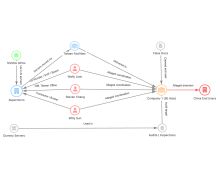
Alleged Supermicro AI Server Diversion Pathway
According to the indictment, the alleged scheme relied on a Southeast Asian intermediary company identified only as “Company-1,” which formally appeared to be the customer while the true end users were allegedly located in China. 1 The indictment says the servers were often assembled in the United States, shipped to the manufacturer’s facilities in Taiwan, delivered to Company-1 elsewhere in Southeast Asia, and then routed onward to purchasers in China through brokers working with the defendants.1 The DOJ press release summarizes the same basic structure, describing Company-1 as a Southeast Asian pass-through entity used to obscure China-based end customers.2
The servers at the center of the case reportedly contained advanced NVIDIA GPUs designed for artificial intelligence applications. The indictment specifically refers to B200, H100, and H200 GPUs and states that advanced AI accelerator chips and servers incorporating them were subject to export licensing requirements for transfers to China and Hong Kong.1 DOJ likewise emphasized that these controls exist because such systems may contribute to military modernization, surveillance, or other activities that U.S. authorities view as contrary to national security interests. 2 These Nvidia GPUs are the leading processors used for training cutting-edge LLM systems, which makes their possible diversion to China a key area of concern.
The scale described in the charging documents is striking. The indictment alleges that, from about 2024 onward, the defendants and their co-conspirators caused the sale of at least approximately $2.5 billion worth of servers to Company-1, with payments passing through financial institutions in the Southern District of New York.1 It further alleges that between late April 2025 and mid-May 2025 alone, more than approximately $510 million worth of U.S.-assembled servers with NVIDIA GPUs were sold to Company-1 and then diverted to China. 1 DOJ repeated those figures in its public statement on the case. 2
According to the indictment, the defendants used a range of methods to conceal the alleged diversion scheme. Prosecutors say they prepared false documents and records, transmitted false communications portraying Company-1 as the end user, used encrypted messaging applications to coordinate responses, and repackaged servers in unmarked boxes before shipment to China. 1 The DOJ press release mirrors those allegations, describing false documents, dummy servers, and transshipment schemes designed to obscure the true destination of restricted AI technology.2
One of the most striking allegations concerns the use of “dummy” servers during audits and inspections. The indictment says the defendants and their co-conspirators staged non-working physical replicas of the manufacturer’s servers at Company-1 warehouses so that compliance personnel would believe the equipment remained in Southeast Asia even though the real systems had already been diverted to China. 1 It further alleges that, ahead of a December 2025 Commerce Department post-shipment verification, Sun and another broker unboxed dummy servers, used a hair dryer to remove and reattach labels and serial number stickers, and then repackaged the replicas in the manufacturer’s boxes. 1 DOJ highlighted the same allegation in its press release, underscoring the government’s claim that the defendants tried to deceive both company auditors and federal officials. 2
The indictment also provides more granular detail on how prosecutors say the alleged scheme survived internal scrutiny. It says that as Company-1’s purchases increased, the manufacturer’s compliance team placed holds on shipments and initiated audits, but that Liaw and Chang took steps to remove those holds and undermine the review process. 1 Among other things, the indictment alleges that Chang worked with Company-1 executives to manage access during audits, arranged for a “friendly” auditor, and helped produce false lease agreements to suggest that Company-1 had enough data-center capacity to store the servers it was buying. 1
Supermicro has sought to draw a firm distinction between the alleged conduct of the defendants and the company itself. In his letter, Liang said Supermicro was not named as a defendant and insisted the alleged conduct contravened company policy and compliance controls.3 The company later announced that its independent directors had launched a formal investigation led by Lead Independent Director Scott Angel and Audit Committee Chair Tally Liu.4 Supermicro said the review would include the conduct at issue in the indictment as well as broader oversight of the company’s Global Trade Compliance Program, with support from Munger, Tolles & Olson and AlixPartners.
The case reflects a broader pattern that has emerged as U.S. controls on advanced semiconductors and AI hardware have tightened. Prosecutors increasingly allege that brokers, distributors, and intermediary companies in third countries are used to disguise the ultimate destination of controlled technology. In that respect, the Liaw case is significant not only because of the identities of the defendants, but also because of the scale, duration, and operational detail laid out in the indictment.
Whether prosecutors can prove those allegations remains to be seen. But the indictment, read alongside the DOJ announcement, Supermicro’s public response, the board’s investigation update, and subsequent reporting, offers an unusually detailed picture of how authorities believe advanced AI hardware can be moved from the United States to China despite increasingly strict export controls.
- ^United States v. Yih-Shyan “Wally” Liaw, Ruei-Tsang “Steven” Chang, and Ting-Wei “Willy” Sun, Sealed Indictment, United States District Court for the Southern District of New York, Case 1:26-cr-00100-ER, filed March 17, 2026, unsealed March 19, 2026.
- ^U.S. Department of Justice, “Three Charged with Conspiring to Unlawfully Divert Cutting Edge U.S. Artificial Intelligence Technology to China,” March 19, 2026, https://www.justice.gov/opa/pr/three-charged-conspiring-unlawfully-divert-cutting-edge-us-artificial-intelligence.
- ^Super Micro Computer, “A Letter From CEO Charles Liang,” March 26, 2026, https://ir.supermicro.com/news/news-details/2026/A-Letter-From-CEO-Charles-Liang-2026-LfRyW8BDwq/default.aspx.
- ^Super Micro Computer, “Supermicro Provides Update on Investigation by Independent Board Directors,” April 7, 2026, https://ir.supermicro.com/news/news-details/2026/Supermicro-Provides-Update-on-Investigation-by-Independent-Board-Directors/default.aspx.